Research & Blog


Our Podcast

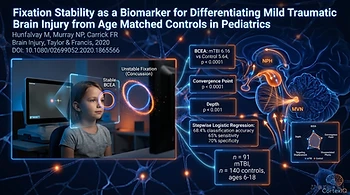
Fixation Stability as a Biomarker for Differentiating Mild Traumatic Brain Injury from Age Matched Controls in Pediatrics
Hunfalvay M, Murray NP, Carrick FR · Brain Injury, Taylor & Francis, 2020
BCEA: mTBI 6.16 vs Control 5.64 (p < 0.0001), with significant differences in convergence point (p < 0.0001) and depth (p < 0.001). Stepwise logistic regression reached 68.4% classification accuracy, 65% sensitivity and 70% specificity (n = 91 mTBI, n = 140 controls, ages 6–18).
Read the study

Vertical Smooth Pursuit as a Diagnostic Marker of Traumatic Brain Injury
Hunfalvay M, Roberts C-M, Murray NP, Tyagi A, Barclay KW, Bolte T, Kelly H, Carrick FR · Concussion, Future Medicine, 2020, Vol 5, Issue 1, Article CNC69
Smooth pursuit variance F(3,88) = 4.52 (p = 0.005) and SP% F(3,88) = 3.80 (p = 0.013) differed across injury severity, with an AUC of 0.772, 68% sensitivity and 73% specificity (N = 92).
Read the study

Exercise and Brain Health in Postmenopausal Women
April Flynn, Ahmed Hankir, Mahera Abdulrahman, Nouf Al-Rumaihi, Frederick Robert Carrick
Estrogen decline drives reduced synaptic plasticity, mitochondrial dysfunction, neuroinflammation and cortical hyperexcitability. Exercise raises BDNF, increases hippocampal volume, lowers TNF-α and IL-6 and improves cerebral blood flow — prescribed 45–60 min, 3–5× per week, for 12+ weeks — with gains in executive function, memory, global cognition and attention.
Read the study

The Risk of Vestibular Disorders with Semaglutide and Tirzepatide: Findings from a Large Real-World Cohort
Eman A. Toraih, Awwad Alenezy, Mohammad H. Hussein, Shahmeer Hashmat, Saitej Mummadi, Nawaf Farhan Alrawili, Ahmed Abdelmaksoud, Manal S. Fawzy
In a large real-world cohort, GLP-1 receptor agonists were associated with a raised risk of vestibular disorders — semaglutide HR 4.02–4.95 and tirzepatide HR 3.19–4.55 — with BPPV the dominant subtype at 67.3% and a relative risk of semaglutide versus tirzepatide of 1.53–2.04 over time.
Read the study